

Chatham House fellow gives evidence on China and critical minerals to UK Parliament Business and Trade sub-Committee
News release
LToremark
Senior Research Fellow for China and the World James Kynge provided evidence on 22 April.

Senior Research Fellow James Kynge gave oral evidence to the Business and Trade Sub-Committee on Economic Security, Arms and Export Controls in its new inquiry looking at the role of critical minerals, which forms part of the sub-Committee’s work on UK national economic security. The session was chaired by Liam Byrne MP.
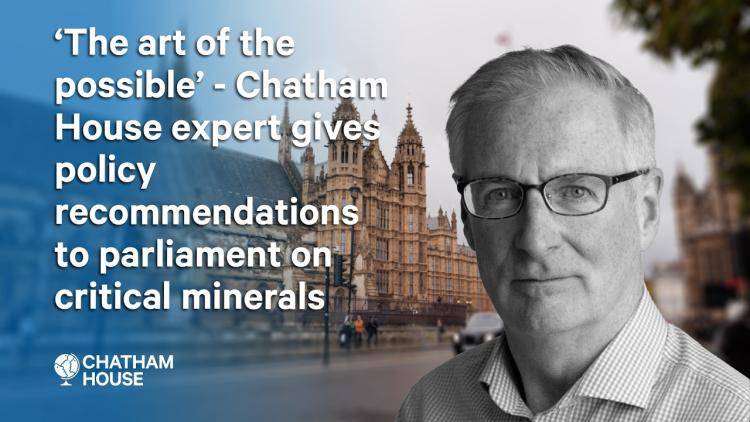
James Kynge was invited to provide evidence due to his expertise on China and its dominance of critical minerals supply chains.
During the session he was asked a range of questions, including in which areas China is particularly strong; whether future UK military equipment – like anti-tank missiles – would rely on Chinese components; about the need for diplomacy; which UK sectors are particularly vulnerable; about interdependencies and whether China weaponizing supply chains for a sustained period of time would lead to mutually assured destruction; and how the UK could work with allies to build resilience.
His main points were that the UK should embrace with real urgency the task of building up its critical minerals resilience. If the UK remains exposed to China’s weaponization of its critical minerals supply chain – as happened in October last year – it leaves itself vulnerable to economic coercion. It is China’s most effective chokehold.
James Kynge said:
‘The optimum policy for the UK is a hybrid one. London should first get clear where its main vulnerabilities lie. Then it should formulate a detailed strategy to protect against the exploitation of these vulnerabilities by foreign powers. After this, it should engage in trade and investment with full vigour in all non-circumscribed areas, including with Chinese companies.
In the case of rare earths and critical minerals, such a strategy should involve the following. First, it should cooperate with allies under the Pax Silica initiative to build rare earth supply chains that are insulated from China. Second, it should actively court foreign investors to mine, refine and even manufacture in the UK. Third, it should provide conducive policies to support the recycling of products (magnets, batteries etc) that contain rare earths to diversify sources of supply.’